Wednesday, March 4, 2015

A Beautiful Orchestra Come from Shaken Bamboos

Best regards for anyone who read my entire blog. I glad to say that it's been my 10th post for this blog.. And for this time, I'll take you to my hometown, Bandung! I've told you about Baker Street before, but why didn't I think to explore my own city?

As wikipedia said, Bandung (/ˈbændʊŋ/ or /ˈbɑːndʊŋ/) (IndonesianKota Bandung) is the capital of West Java province in Indonesia and the country's third largest city by population with a sprawling urban population of 8.6 million in 2011. Located 768 metres (2,520 ft)above sea level, approximately 140 kilometres (87 miles) south east of Jakarta, Bandung has cooler temperatures year-round than most other Indonesian cities. The city lies on a river basin surrounded by volcanic mountains. This topography provides a good natural defense system, which was the primary reason for the Dutch East Indies government's plan to move the colony capital from Batavia to Bandung.

But for me personally, Bandung is the city of live, city of love, and city of life! It was a city I was born in, a city I live in, and a  city I study at! Although, both of my parents aren't originally came from Bandung even West Java, but since I was born and growing up here, I love this city so much.

West Java 's population is 46.3 million (in 2014) and it is the most populous and most densely populated of Indonesia's provinces. This province has many traditional music instruments especially that made of bamboo. The three main types of Sundanese bamboo ensembles are angklung, calung, and arumba. The exact features of each ensemble vary according to context, related instruments, and relative popularity.


Angklung with eight pitches

Angklung is a generic term for sets of tuned, shaken bamboo rattles. Angklung consists of a frame upon which hang several different lengths of hollow bamboo. Angklungs are played like handbells, with each instrument played to a different note. Angklung rattles are played in interlocking patterns, usually with only one or two instruments played per person. The ensemble is used in Sundanese processions, sometimes with trance or acrobatics. Performed at life-cycle rituals and feasts (hajat), angklung is believed to maintain balance and harmony in the village. In its most modern incarnation, angklung is performed in schools as an aid to learning about music.
The Angklung got more international attention when Daeng Soetigna, from Bandung, West Java, expanded the angklung notations not only to play traditional pélog or sléndro scales, but also diatonic scale in 1938. Since then, angklung is often played together with other western music instruments in an orchestra. One of the first well-known performances of angklung in an orchestra was during the Bandung Conference in 1955.
I like the angklung orchestra a lot. And since I got a task to visit a spot that I've never been there before, so I decided to go to Saung Angklung Mang Udjo which is located at Padasuka Street number 118, Bandung City.
Bandung Map
On last Sunday morning, I went to Saung Angklung Mang Udjo by car with my parents, yeah, both of them. We went there without any preparation. We hadn't even read any information about it. So we went at 10 and arrived at about 11. And, guess what? The show would start at 15.30! And we had to wait for about 3 and half hours. We decided to wait a while and looked the process of making angklung until the Dhuhur time came so we could have Dhuhur prayer then had a lunch.


Since the picture of how to make angklung there wasn't really clear, so I copy-paste the making angklung process from its official website. Here they are.

Making Angklung

1. Choosing The Bamboo


Bamboo is the material of an Angklung. It is choosing by its age. It has to be at least 4 years old and not more than 6 years old. It is cut in the dry season, between 9 am and 3 pm at the afternoon. After being cut at its base, with the size about 2-3 span of the hand, it should be stored for about 1 week, so that the bamboo will contain less water.

After a week, the bamboo should be separated from its branches. It should be cut into certain various sizes. Then, it should be stored for about one year to prevent it from termites. Some of the procedures are: by sinking out the bamboo beneath mud field, pool or river, also by smoking it at the fireplace, and the modern procedure: by using a certain liquid chemistry formula.

2. The Parts Of Angklung


Each Angklung consist of 3 parts:
The Voice TubesThe most important part of an Angklung, is the voice tubes which produce intonation. Tuning process makes the intonation.
The FrameFrame supports the voice tubes to stand inside the hollow space.
The BaseIt functions as the frame of the voice tubes.

3. Tuning The Voice Tube Process


Half-Done ProcessIt is the process of Shaping the bamboo become laths of voice tube.
Resonance Tuning ProcessIt is the process of blowing the lower part of an Angklung to the floor and measuring it to the tuner.
Main Voice Tuning ProcessIt is the process of  tuning the voice by increasing and decreasing the tone by striking voice. Also it is the process of increasing the tone by cutting its upper parts slightly, and decreasing the tone by shaping both voice laths with shaping knife.
How to Use a Tuner:
  • To use a tuner, we should pay attention to both of the lamps on the left and the right of the panel, and also the pointer needle.
  • For example, if you’re going to make an “F” tone, you should shake the Angklung while paying attention to both of the lamps which will flame together, and the to pointer needle which will point the “F” letter.

4. Finishing


After each of the voice tubes has its tone, it should be put into the frame laths and be tied of rattan rope.

5. Maintenance


Re-Tuning Angklung
1. If the tone of angklung is higher than the normal tone, the angklung (side A) can be whittled by knife little by little until it reaches the tone wished.
2. If the tone of angklung is lower than the normal tone, the end of angklung (side B) can be cutr little by little until it reaches the normal tone.
Maintain Angklung
Since Angklung is made of bamboo, its construction and endurance are not as good as those of metallic things. Therefore, it needs good maintenance and storage. Good Angklung is made of old and dry bamboo. It takes at least one year to store the bamboo material in order to get the proper/high-pitched voice and to prevent termites. It endurances can be fifteen years, providing it is in a good maintenance.
In our place (Saung Angklung Udjo) we have tried to make the Angklung from the very dry bamboo. However, nowadays we haven’t got the supply of one – year-old bamboo, but only eight – month – old one. This condition is caused by the limitation of its availability and storage. Moreover, it needs high production cost.


It was so boring, waiting the show to begin inside the car. And I was like, " It's better to change the destination rather than waiting here the whole day." But, 1 hour pass, 2 hours pass and I was asleep, 3 hours pass, and finally, it's show time!

We got in the hall a bit late since we had Ashar prayer which is just end a minute before the show began. We had bought the ticket a half hour before the show. The ticket was in the form of a necklace with a mini angklung on it. We had to use it during the show. 

The show was so amazing and memorable. Begun with the wayang golek show, then the arak-arakan sunat ceremony, merak dance, and many angklung show. There were the angklung traditional music play, continued with playing angklung together guided by the grandson of the owner of Saung Angklung Mang Udjo, and the last angklung show was the most beautiful angklung orchestra I've ever heard. Played by some teenagers, each person played about 10 angklungs and they brought 3 musics. And the most wonderful was Bohemian Rhapsody by The Queen, one of legendary pop-rock music and also one of the hardest music.

Over all it was toootally cool experience. There's no need to regret any of things I've got that day. The show was worth the best praise! I'm sorry but I can't post the picture of the show because it may causes some problems of copyright. Thanks for reading. Highly recommended to visit this cultural Bandung spot! With only 60kIDR!


website sources :

Tuesday, February 10, 2015

Black "Piercing Star" Hole


“(I swear) by Heaven and the Tariq! And what will convey to you what the Tariq is? The Star Piercing (the darkness)!” (Qur’an, 86:1-3)

You must be wondering, what the connection between the title (Black "Piercing Star" Hole) and the ayah above? The term used in the verse is ‘althaqibu,’ meaning piercing, opening a hole, penetrating and passing through, from the root ‘thaqaba,’ meaning ‘hole.’ The word used in scientific publications when black holes are being described is ‘puncture.’ There is a considerable wisdom in the use of this word to describe the features of black holes in the Qur’an. The fact that this property of stars is mentioned in the Qur’an is important evidence that the Qur’an is indeed the very word of Allah.
The 20th century saw a great many new discoveries regarding celestial phenomena in the universe. One of these entities, which has only recently been encountered, is the Black Hole. These are formed when a star which has consumed all its fuel collapses in on itself, eventually turning into a black hole with infinite density and zero volume and an immensely powerful magnetic field. We are unable to see black holes even with the most powerful telescope, because their gravitational pull is so strong that light is unable to escape from them. However, such a collapsed star can be perceived by means of the effect it has on the surrounding area. 
black hole is a mathematically defined region of spacetime exhibiting such a strong gravitational pull that no particle orelectromagnetic radiation can escape from it.[1] The theory of general relativity predicts that a sufficiently compact masscan deform spacetime to form a black hole.[2] The boundary of the region from which no escape is possible is called theevent horizon. Although crossing the event horizon has enormous effect on the fate of the object crossing it, it appears to have no locally detectable features. In many ways a black hole acts like an ideal black body, as it reflects no light.[3][4]Moreover, quantum field theory in curved spacetime predicts that event horizons emit Hawking radiation, with the same spectrum as a black body of a temperature inversely proportional to its mass. This temperature is on the order of billionths of a kelvin for black holes of stellar mass, making it essentially impossible to observe.
Objects whose gravitational fields are too strong for light to escape were first considered in the 18th century by John Michell and Pierre-Simon Laplace. The first modern solution of general relativity that would characterize a black hole was found by Karl Schwarzschild in 1916, although its interpretation as a region of space from which nothing can escape was first published by David Finkelstein in 1958. Long considered a mathematical curiosity, it was during the 1960s that theoretical work showed black holes were a generic prediction of general relativity. The discovery of neutron stars sparked interest in gravitationally collapsed compact objects as a possible astrophysical reality.
Black holes of stellar mass are expected to form when very massive stars collapse at the end of their life cycle. After a black hole has formed, it can continue to grow by absorbing mass from its surroundings. By absorbing other stars and merging with other black holes, supermassive black holes of millions of solar masses (M) may form. There is general consensus that supermassive black holes exist in the centers of most galaxies.
Despite its invisible interior, the presence of a black hole can be inferred through its interaction with other matter and withelectromagnetic radiation such as light. Matter falling onto a black hole can form an accretion disk heated by friction, forming some of the brightest objects in the universe. If there are other stars orbiting a black hole, their orbit can be used to determine its mass and location. Such observations can be used to exclude possible alternatives (such as neutron stars). In this way, astronomers have identified numerous stellar black hole candidates in binary systems, and established that the core of the Milky Way contains a supermassive black hole of about 4.3 million M.
Black holes are places where ordinary gravity has become so extreme that it overwhelms all other forces in the Universe. Once inside, nothing can escape a black hole's gravity — not even light.

Yet we know that black holes exist. We know how they are born, where they occur, and why they exist in different sizes. We even know what would happen if you fell into one. Our discoveries have revealed one of the strangest objects in the Universe, and there's still much we don't know.

There are about at least 10 facts about Black Hole. Here they are:


Fact 1: You can’t directly see a black hole.

Because a black hole is indeed “black” — no light can escape from it — it’s impossible for us to sense the hole directly through our instruments, no matter what kind of electromagnetic radiation you use (light, X-rays, whatever.) The key is to look at the hole’s effects on the nearby environment, points out NASA. Say a star happens to get too close to the black hole, for example. The black hole naturally pulls on the star and rips it to shreds. When the matter from the star begins to bleed toward the black hole, it gets faster, gets hotter and glows brightly in X-rays.

Fact 2: Look out! Our Milky Way likely has a black hole.
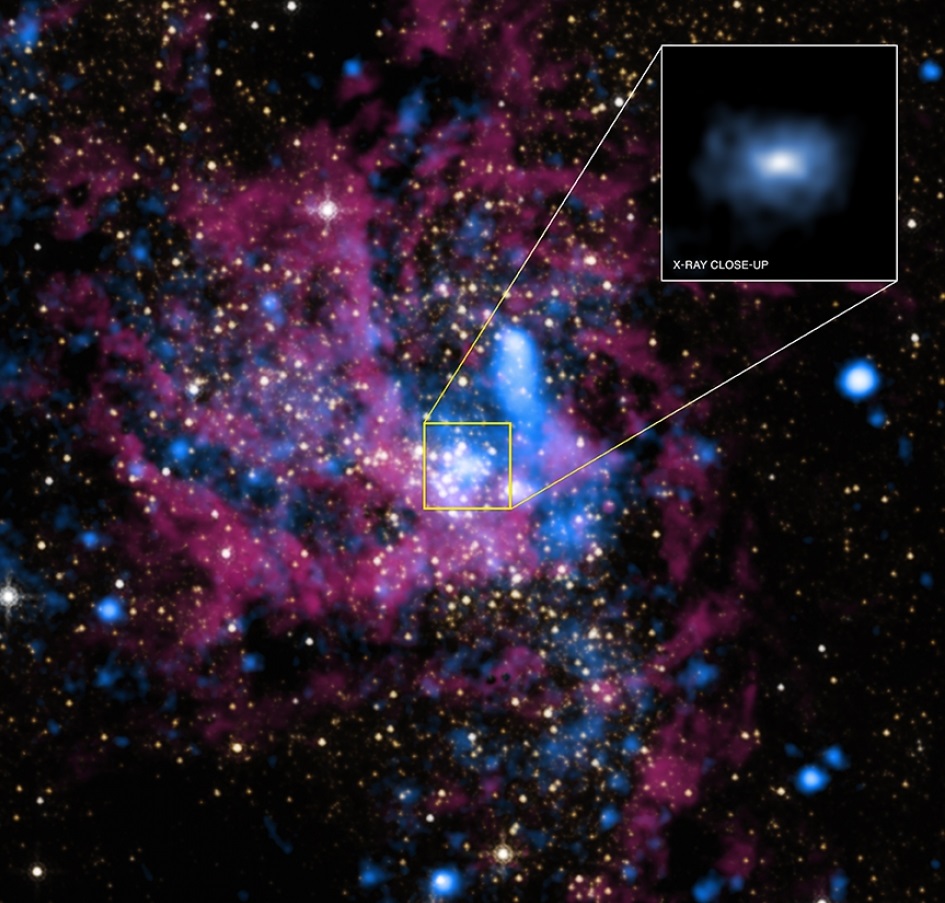
A natural next question is given how dangerous a black hole is, is Earth in any imminent danger of getting swallowed? The answer is no, astronomers say, although there is probably a huge supermassive black hole lurking in the middle of our galaxy. Luckily, we’re nowhere near this monster — we are about two-thirds of the way out from the center, relative to the rest of our galaxy — but we can certainly observe its effects from afar. For example: the European Space Agency says it’s four million times more massive than our Sun, and that it’s surrounded by surprisingly hot gas.
Sagittarius A in infrared (red and yellow, from the Hubble Space Telescope) and X-ray (blue, from the Chandra space telescope). Credit: X-ray: NASA/UMass/D.Wang et al., IR: NASA/STScI
Fact 3: Dying stars create stellar black holes.
Say you have a star that’s about 20 times more massive than the Sun. Our Sun is going to end its life quietly; when its nuclear fuel burns out, it’ll slowly fade into a white dwarf. That’s not the case for far more massive stars. When those monsters run out of fuel, gravity will overwhelm the natural pressure the star maintains to keep its shape stable. When the pressure from nuclear reactions collapses, according to the Space Telescope Science Institute, gravity violently overwhelms and collapses the core and other layers are flung into space. This is called a supernova. The remaining core collapses into a singularity — a spot of infinite density and almost no volume. That’s another name for a black hole.
Fact 4: Black holes come in a range of sizes.
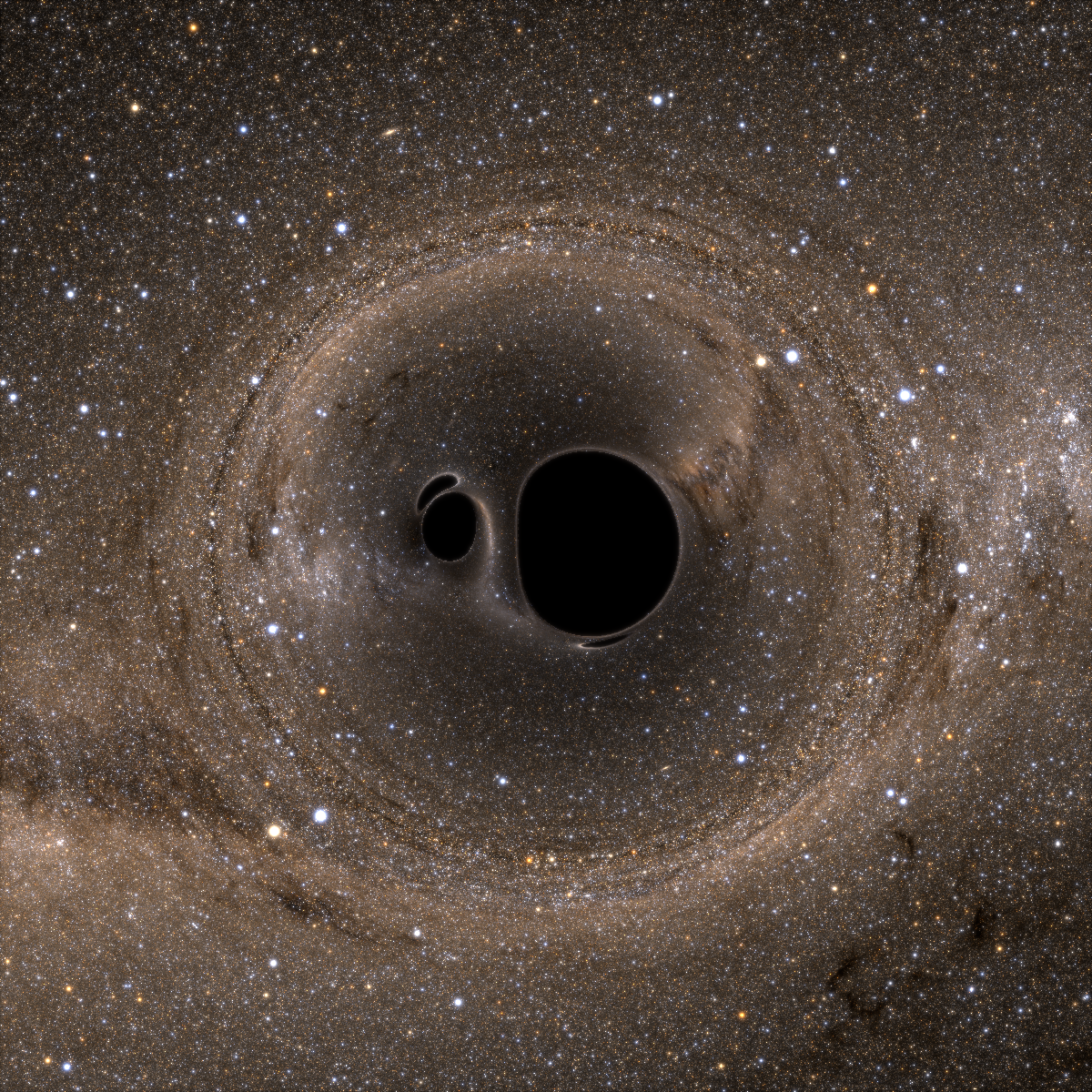
There are at least three types of black holes, NASA says, ranging from relative squeakers to those that dominate a galaxy’s center. Primordial black holes are the smallest kinds, and range in size from one atom’s size to a mountain’s mass. Stellar black holes, the most common type, are up to 20 times more massive than our own Sun and are likely sprinkled in the dozens within the Milky Way. And then there are the gargantuan ones in the centers of galaxies, called “supermassive black holes.” They’re each more than one million times more massive than the Sun. How these beasts formed is still being examined.
A binary black hole system, viewed from above. Image Credit: Bohn et al. (see http://arxiv.org/abs/1410.7775)
Fact 5: Weird time stuff happens around black holes.
This is best illustrated by one person (call them Unlucky) falling into a black hole while another person (call them Lucky) watches. From Lucky’s perspective, Unlucky’s time clock appears to be ticking slower and slower. This is in accordance with Einstein’s theory of general relativity, which (simply put) says that time is affected by how fast you go, when you’re at extreme speeds close to light. The black hole warps time and space so much that Unlucky’s time appears to be running slower. From Unlucky’s perspective, however, their clock is running normally and Lucky’s is running fast.
Fact 6: The first black hole wasn’t discovered until X-ray astronomy was used.
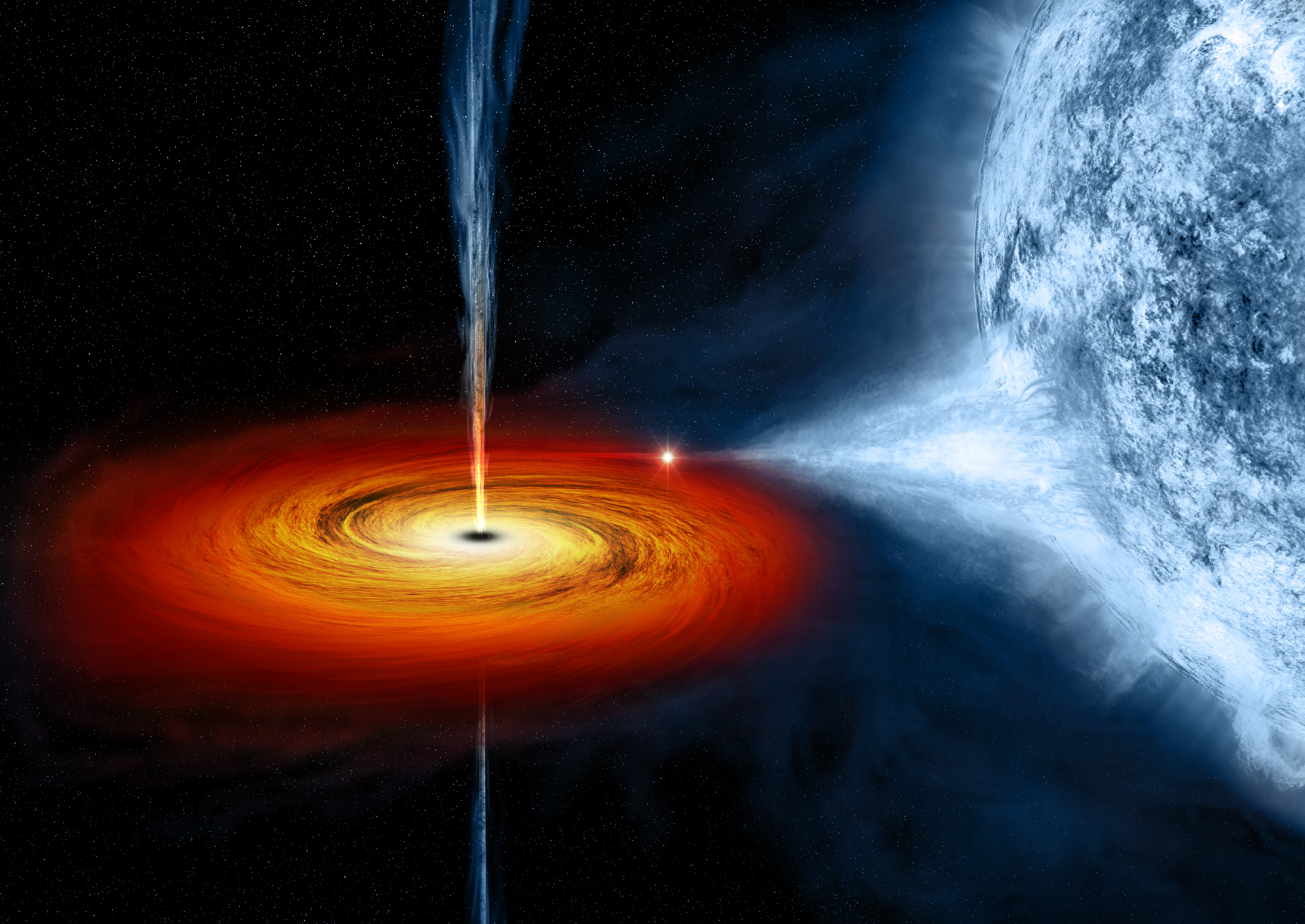
Cygnus X-1 was first found during balloon flights in the 1960s, but wasn’t identified as a black hole for about another decade. According to NASA, the black hole is 10 times more massive to the Sun. Nearby is a blue supergiant star that is about 20 times more massive than the Sun, which is bleeding due to the black hole and creating X-ray emissions.
Illustration of Cygnus X-1, another stellar-mass black hole located 6070 ly away. (NASA/CXC/M.Weiss)
Fact 7: The nearest black hole is likely not 1,600 light-years away.
An erroneous measurement of V4641 Sagitarii led to a slew of news reports a few years back saying that the nearest black hole to Earth is astoundingly close, just 1,600 light-years away. Not close enough to be considered dangerous, but way closer than thought. Further research, however, shows that the black hole is likely further away than that. Looking at the rotation of its companion star, among other factors, yielded a 2014 result of more than 20,000 light years.
Fact 8: We aren’t sure if wormholes exist.
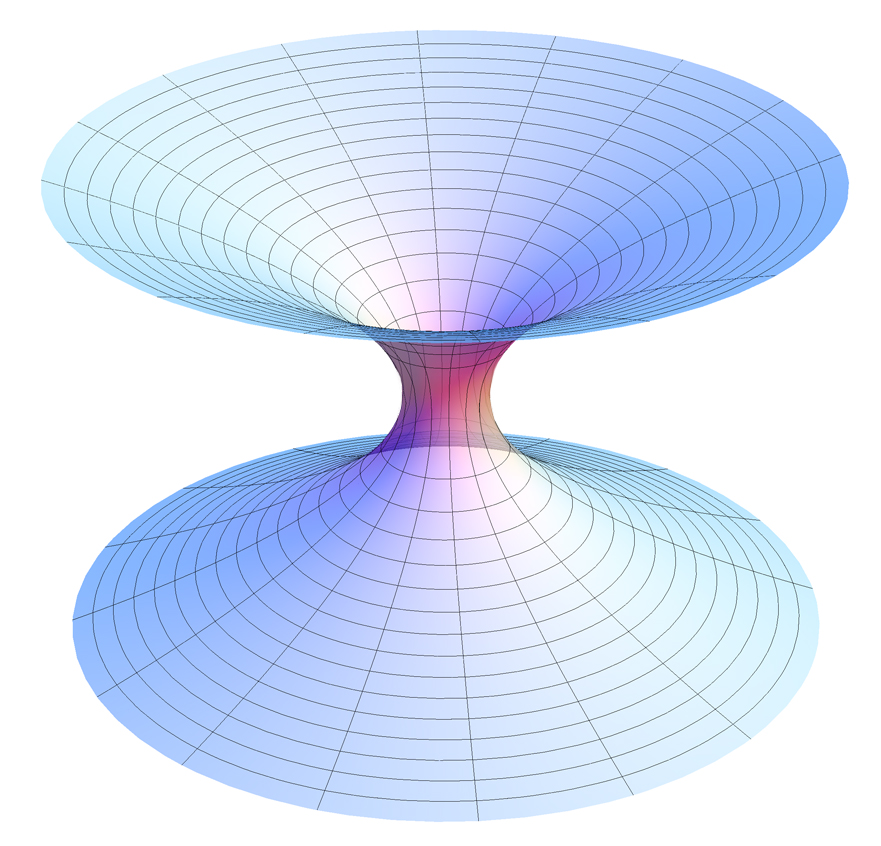
A popular science-fiction topic concerns what happens if somebody falls into a black hole. Some people believe these objects are a sort of wormhole to other parts of the Universe, making faster-than-light travel possible. But as this Smithsonian Magazine article points out, anything is possible since we still have a lot to figure out about physics. “Since we do not yet have a theory that reliably unifies general relativity with quantum mechanics, we do not know of the entire zoo of possible spacetime structures that could accommodate wormholes,” said Abi Loeb, who is with the Harvard-Smithsonian Center for Astrophysics.
Diagram of a wormhole, or theoretical shortcut path between two locations in the universe. Credit: Wikipedia
Fact 9: Black holes are only dangerous if you get too close.
Like creatures behind a cage, it’s okay to observe a black hole if you stay away from its event horizon — think of it like the gravitational field of a planet. This zone is the point of no return, when you’re too close for any hope of rescue. But you can safely observe the black hole from outside of this arena. By extension, this means it’s likely impossible for a black hole to swallow up everything in the Universe (barring some sort of major revision to physics or understanding of our Cosmos, of course.)
Fact 10: Black holes are used all the time in science fiction.
There are so many films and movies using black holes, for example, that it’s impossible to list them all. Interstellar‘s journeys through the universe includes a close-up look at a black hole. Event Horizon explores the phenomenon of artificial black holes — something that is also discussed in the Star Trek universe. Black holes are also talked about in Battlestar:Galactica, Stargate: SG1 and many, many other space shows.


In Surat al-Waqi'a, Allah draws attention this matter in this way, by swearing upon the position of stars:
And I swear by the stars' positions-and that is a mighty oath if you only knew. (Qur'an, 56:75-76)
karadelik

The term "black hole" was first employed in 1969 by the American physicist John Wheeler. Previously, we imagined that we were able to see all the stars. However, it later emerged that there were stars in space whose light we were unable to perceive. Because, the light of these collapsed stars disappears. Light cannot escape from a black hole because it is such a high concentration of mass in a small space. The enormous gravitation captures even the fastest particles, i.e. the photons. For example, the final stage of a typical star, three times the mass of the Sun, ends after its burning out and its implosion as a black hole of only 20 kilometres in diameter! Black holes are "black," i.e. veiled from direct observation. They nevertheless reveal themselves indirectly, by the tremendous suction which their gravitational force exerts on other heavenly bodies. As well as depictions of the Day of Judgement, the verse below may also be pointing to this scientific discovery about black holes:
When the stars are extinguished, (Qur'an, 77:8)
Moreover, stars of great mass also cause warps to be perceived in space. Black holes, however, do not just cause warps in space but also tear holes in it. That is why these collapsed stars are known as black holes. This fact may be referred to in the verse about stars, and this is another important item of information demonstrating that the Qur'an is the Word of Allah:
[I swear] by Heaven and the Tariq! And what will convey to you what the Tariq is? The Star Piercing [the darkness]! (Qur'an, 86:1-3)

 Almighty Allah provided information about “black holes” in the Qur’an as well as other celestial bodies at a time when mankind knew nothing about celestial bodies.

Information from black holes
Stephen Hawking, the world-famous British physicist, has said that a black hole begins producing nuclear energy when it forms, and that the radiation that forms can provide information about what is inside the black hole.
Stephen Hawking’s obtaining such information is most interesting because this theory is a clear manifestation of Almighty Allah’s title of Al-Hafiz (The Preserver), “He Who preserves all things in detail,” and this has been scientifically proved by the renowned physicist.
In the sight of Allah, everything has taken place and finished in a moment. Since the beginning of time, everything has taken place in this single moment. In the sight of Allah, all information pertaining to this moment is kept in a “Book.” This “Main Book,” or as the Qur’an calls it, “The Mother of the Book,” holds every bit of information about everything: 
“Certainly there is no hidden thing in either heaven or earth which is not in a Clear Book.” (Qur’an, 27:75)
The Book will be set in place and you will see the evildoers fearful of what is in it. They will say, “Alas for us! What is this Book which does not pass over any action, small or great, without recording it?” 
“They will find there everything they did and your Lord will not wrong anyone at all.” (Qur’an, 18:49) 
Allah has created everything, living or non-living, which has existed since the beginning of the universe and all events which have happened. Consequently, Allah is cognizant of them all. To put it in another way, “They all exist in the memory of Allah.” In this sense, the Mother of the Book is a manifestation of Allah’s attribute, the Al-Hafiz.
One of the miraculous features of the Qur’an proving that it is the word of Allah is these verses referring to black holes. Thanks to the way that the verses of the Qur’an may bear several meanings, it is highly probable that many more miracles of the Qur’an will emerge in the years to come. (Allah alone knows the truth of all things.) 
As the word of Almighty and Omniscient Allah, the Qur’an contains much information that people do not understand, or which they as yet lack the knowledge to understand. This information comes to light by means of technological and scientific advances taking place at a time and level of our Lord’s choosing, thus confirming the miraculous nature of the Qur’an.

Destined to eternity
At this point, we come upon a striking fact; because the memory of Allah is infinite, nothing existent in Him becomes lost. In other words, no living being created by Allah vanishes, no flower fades, no drink finishes, no period comes to an end, and no food is consumed. Every moment Allah creates and every exact detail of everything are created in eternity and it is “destined to eternity.”
This explanation may be put in the following way: Eternity has begun for a being or an event by the time it is created. For instance, when a flower is created, it is, in reality, destined not to disappear. That this being ceases to become a part of one’s sensations and is erased from one’s memory does not actually mean that it has vanished or died. Its state in the Sight of Allah is what actually matters. Furthermore, all states of this being, be it its creation, all moments throughout its life or death, exist in the Memory of Allah.
Upon all that is created, Allah bestows eternity. In other words, existing things have attained eternity by the time they are created. To have a thorough grasp of this notion, however, one needs to reflect on all beings and events individually. 
But, before proceeding with this subject, it would be useful to stress the following fact; what has been stated so far, together with the following, is no doubt the most important information one can ever acquire in one’s lifetime. 
Most probably, many people are hearing and reflecting on these facts about timelessness for the first time in their lives. However, here is something important to keep in mind: Allah, in the Qur’an, draws our attention to the fact that “only those who sincerely turn to Allah” take heed. In other words, only those who truly seek the guidance of our Lord and endeavor to appreciate His infinite might and His greatness will heed these explanations and have a grasp of these facts.